- AI Engineering
- Posts
- Harvard Released a Free Book on ML Systems Engineering
Harvard Released a Free Book on ML Systems Engineering
.. PLUS: Context Data Platform for Self-Learning Agents

Sumanth P
December 02, 2025
In today’s newsletter:
Acontext - Context Data Platform for Self-Learning Agents
Better Agents - Open Project Structure for building AI Agents
Free Book on ML Systems Engineering from Harvard
Reading time: 3 minutes.
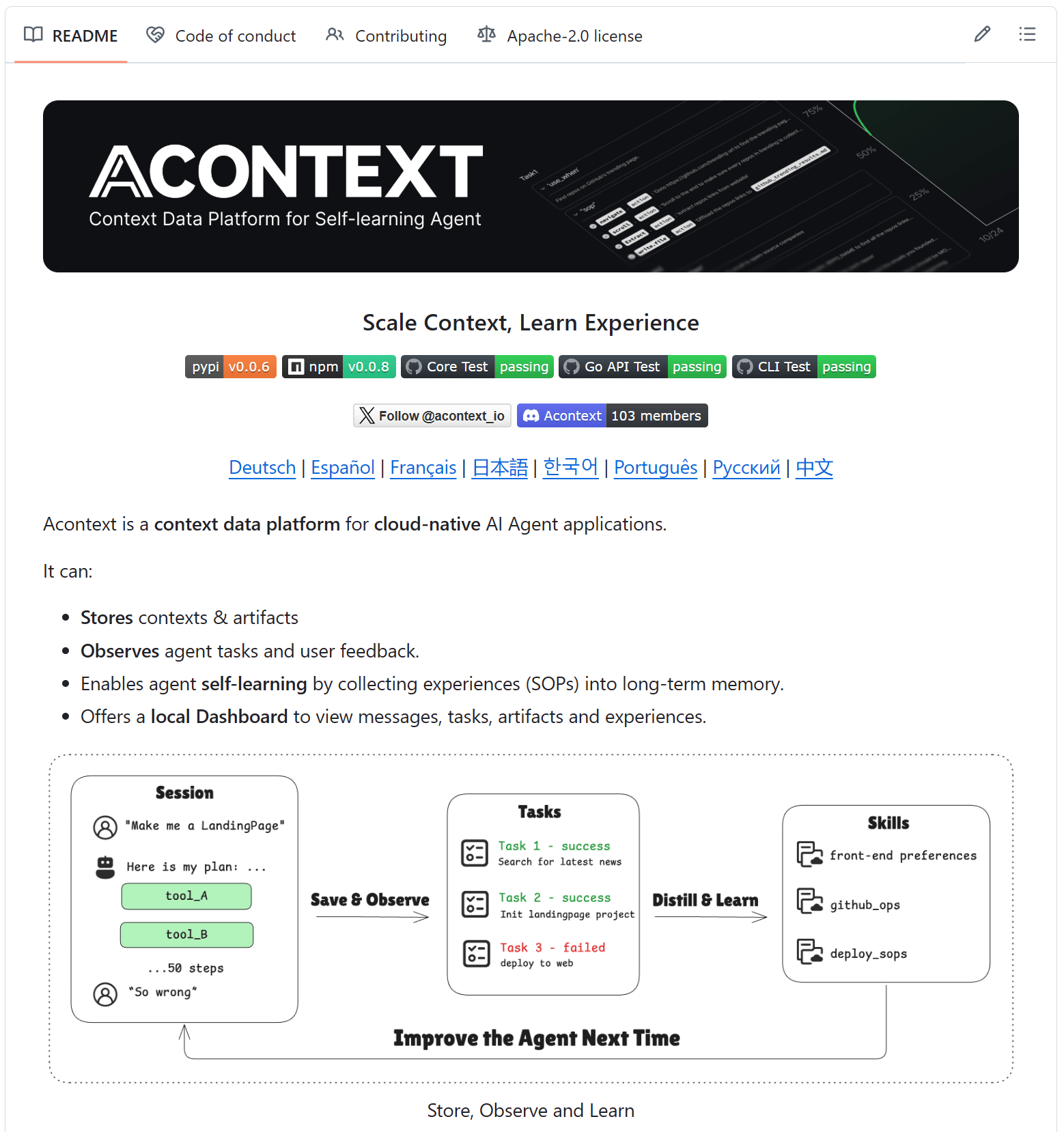
Acontext is an open source context data platform that simplifies context engineering by letting agents remember what they did, what worked, and what they learned.
Instead of resetting every session, it captures conversations, tasks, artifacts, and outcomes so agents can reuse past knowledge.
How It Works:
Acontext follows a simple model: Store → Observe → Learn.
It monitors agent runs, stores all messages and artifacts, and converts successful steps into structured SOPs inside a workspace called Spaces.
Over time, this creates a library of reusable workflows the agent can draw from.
Key Features:
Long-term memory for agent runs - Persist entire histories of interactions and outputs.
Conversation, artifact, and trace storage - Capture inputs, outputs, tools invoked, and intermediate steps.
Workflow distillation into SOP pages - Successful runs become structured task guides in a Notion-like interface.
Local-first setup - Deploy using Docker with a minimal local footprint.
Simple API integration - Works with any agent framework through a straightforward API layer.
It’s 100% Open Source
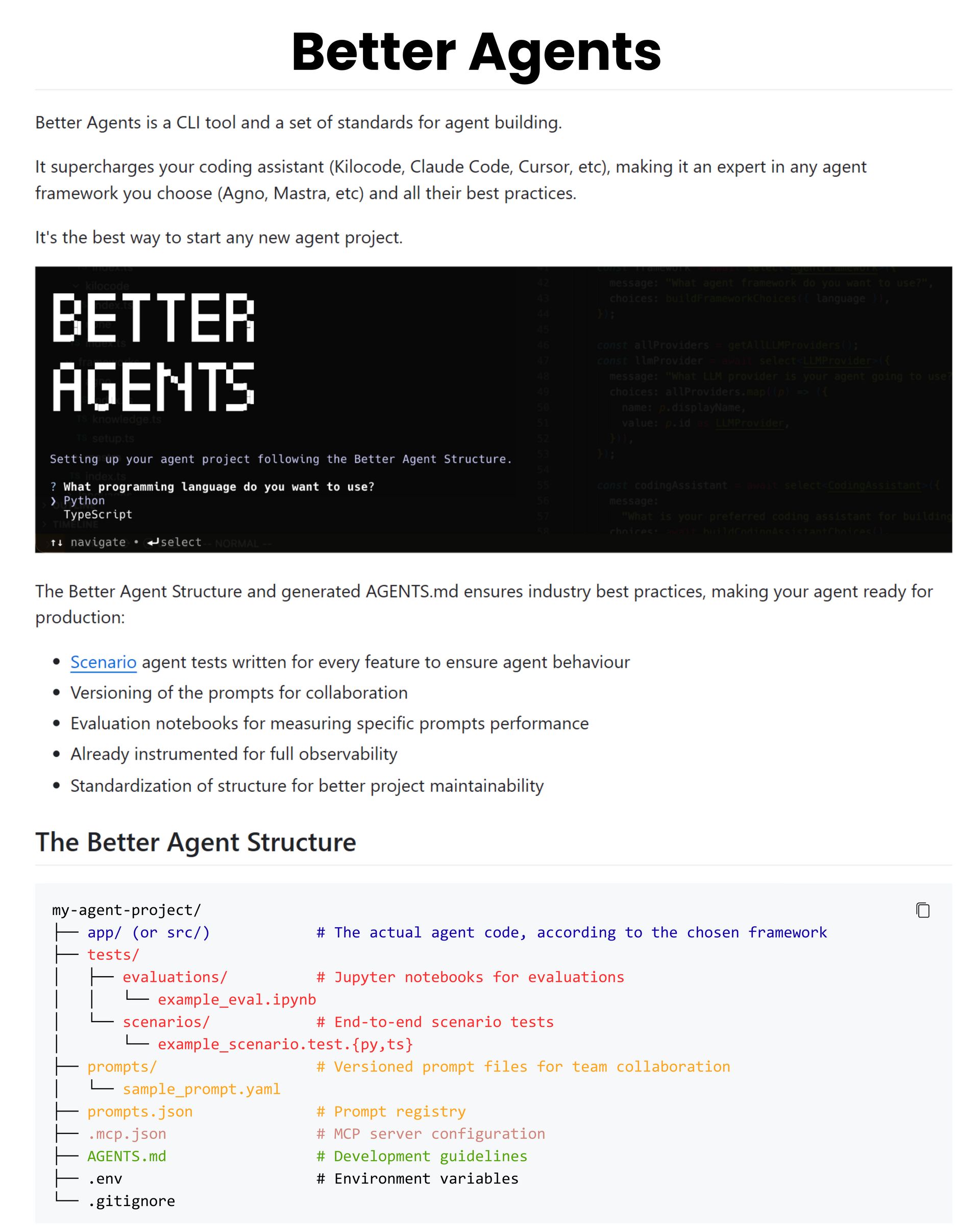
Better Agents is a CLI tool and standards kit for building production-ready agent projects.
Most agentic projects start without a real structure. Testing, evaluation, and prompt versioning get added only when things break, which slows teams down and makes it hard to build agents you can trust.
Better Agents fixes this by giving you a clean project structure, versioned prompts, scenario tests, and a clear AGENTS.md that describes each capability and how it should be evaluated.
It is the best way to start any new agent project.
Key Capabilities:
Scenario tests for every feature (agent simulations to end-to-end tests for complex agentic systems)
Prompt versioning that keeps collaboration and iteration clean
Evaluation notebooks with datasets for measuring specific parts of your pipeline, including RAG and classification tasks
Works with any agentic framework including Agno, Mastro, and others while enforcing consistent best practices
Built-in observability to inspect and debug agent runs
A standardized layout that keeps projects maintainable as they scale
It is 100% Open Source.
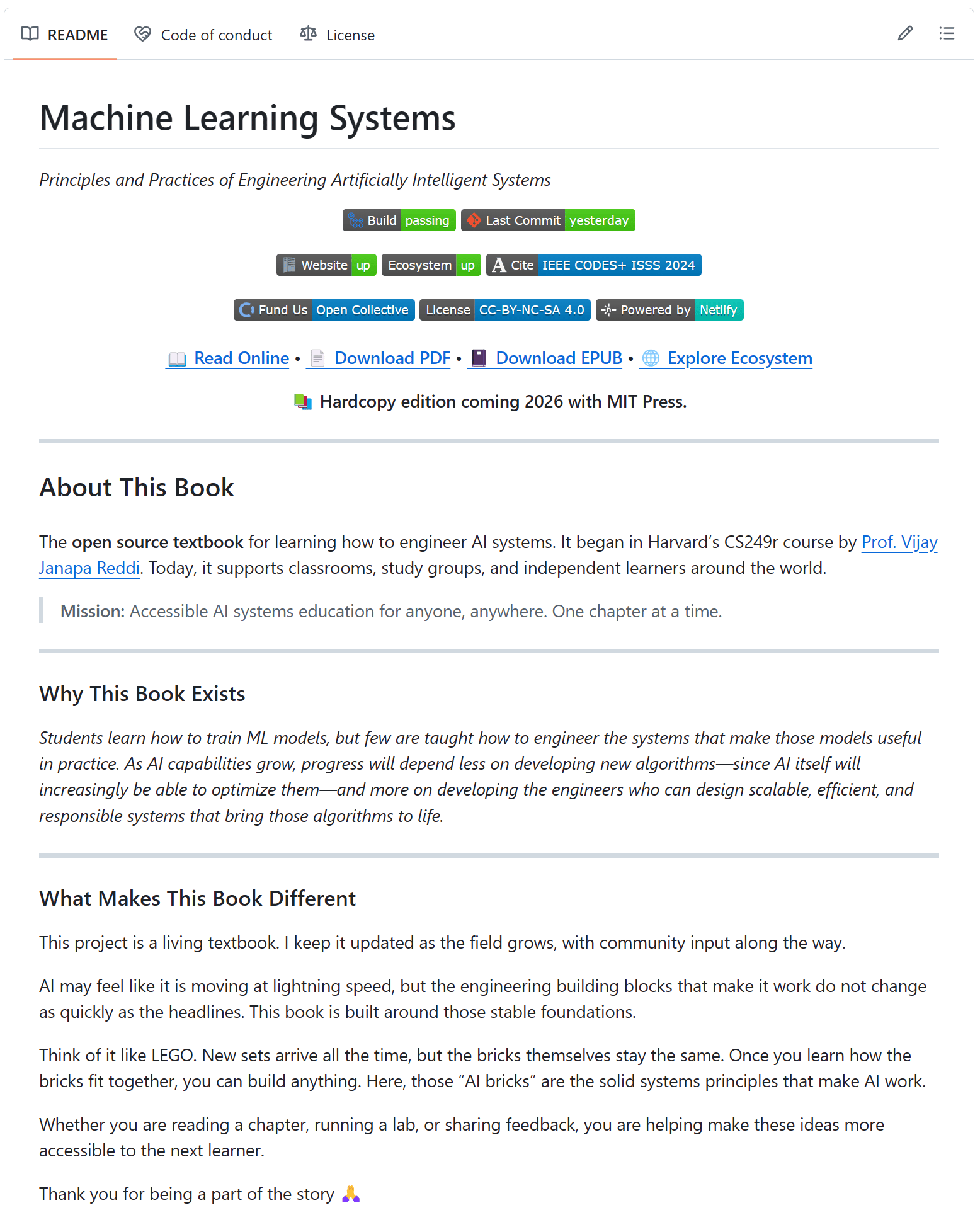
Harvard published a comprehensive, free book on ML systems engineering a practical guide for designing, building, and operating real-world machine learning systems.
The book focuses on end-to-end production workflows and offers technically grounded guidance on system architecture, data pipelines, deployment, and long-term operations.
What’s Inside:
System Design: Structuring scalable, modular ML systems that can evolve with product needs.
Data Engineering: Building reliable pipelines for data collection, labeling, transformation, and quality management.
Model Deployment: Converting trained models into robust, production-ready services with clear interfaces and operational guarantees.
MLOps & Monitoring: Operating and sustaining ML services with automation, observability, and continuous evaluation.
Edge & Embedded AI: Techniques for deploying ML models on mobile, embedded, and resource-constrained devices.
Responsible AI: Integrating privacy, security, evaluation rigor, and environmental considerations into the system lifecycle.
The entire book is available for free, along with an open-source repo.
🔗 Check out the Book and Github Repo
That’s a Wrap
That’s all for today. Thank you for reading today’s edition. See you in the next issue with more AI Engineering insights.
PS: We curate this AI Engineering content for free, and your support means everything. If you find value in what you read, consider sharing it with a friend or two.
Your feedback is valuable: If there’s a topic you’re stuck on or curious about, reply to this email. We’re building this for you, and your feedback helps shape what we send.
WORK WITH US
Looking to promote your company, product, or service to 160K+ AI developers? Get in touch today by replying to this email.